

Investing with clarity, conviction and long-term perspective.
Core's disciplined investment approach is built on quality, transparency and long-term thinking to help you grow wealth with confidence.
Core’s investment philosophy is grounded in a disciplined, long-term approach that combines thematic awareness with fundamental analysis and value-oriented decision making.
Long-term thinking.
Lasting results.
Core believes that successful investing is not driven by short-term market movements, but by identifying and owning high-quality assets that can generate wealth over time.
Our philosophy is anchored in the principle that the underlying metrics of a business ultimately determine its long-term value and share price performance.
Quality over speculation
Long-term wealth is created through disciplined ownership of quality assets, not through speculation or short-term trading.
Long-term value matters
Markets can be volatile in the short term, but fundamentally sound businesses will reflect their intrinsic value over time.
Stay resilient
Economic cycles are inevitable. Portfolios should be constructed to withstand and adapt to changing market conditions.
Diversify with purpose
Diversification is essential, but it must be purposeful and aligned to your risk and return objectives.
Discipline drives results
Investor behaviour has a significant impact on outcomes. Consistency and discipline are critical to long-term success.

Investing with clarity, conviction and long-term perspective.
Core invests in what works.
Quality businesses with strong fundamentals, sustainable earnings, proven track records, and reliable dividends; because that is what builds lasting wealth.

We analyse the economics that drive long-term value. We focus on established companies with market-leading positions. We build portfolios with lower volatility, so your returns smooth out over time. And we adapt as markets shift, because rigid strategies don’t work in a changing world.

Owning quality shares and real assets on stock exchanges gives you liquidity, transparency, and lower costs. No unnecessary layers.

In 2025, our portfolios outperformed benchmarks across the board. Australian Equities at 13.0%, International Equities at 12.6%, and balanced superannuation strategies delivering 10.5% to 13.2%.
A well-managed portfolio is more than a collection of investments.
It's an active strategy designed to evolve with changing markets and your financial goals. Core builds diversified portfolios through thoughtful asset allocation, balancing growth opportunities with risk management to create a strategy tailored to you.
Through ongoing portfolio reviews, active management and disciplined decision-making, Core continually assesses market conditions and makes considered adjustments where appropriate. Our focus is on preserving capital, capturing long-term opportunities and ensuring your portfolio remains aligned with the future you're working towards.

Portfolio Construction Approach
Our portfolio construction process is deliberate, research-driven, and aligned to your objectives, risk profile and investment timeframe.
Core constructs portfolios using a combination of strategic asset allocation and active security selection. Strategic asset allocation provides the foundation for long-term returns, while tactical adjustments allow portfolios to respond to evolving market conditions.
Quality bias
Preference for companies with strong market positions, pricing power and consistent earnings.
Diversification across asset classes
Exposure to equities, income assets and, where appropriate, property and alternative investments.
Global perspective
Inclusion of both Australian and international assets to broaden diversification and access multiple markets.
Direct investment preference
Utilisation of direct listed securities to improve transparency, flexibility and portfolio control.
Selective Use of Managed & Passive Investments
Applied where they enhance efficiency, diversification or access to specific markets.
Professionally managed portfolios.
Actively managed portfolios focused on quality assets, disciplined investing and long-term sustainable returns.
Core Australian Equities Portfolio
A concentrated long only portfolio providing exposure to leading Australian companies which will typically be biased to companies that have higher forecast dividend yields relative to other ASX listed companies.
Risk Level
Very High
Suggested Term
7 years
Core Property & Infrastructure Portfolio
The portfolio consists of Australian and international listed and unlisted property and infrastructure assets with a focus on income.
Risk Level
High
Suggested Term
7 years
Core Income
A diversified portfolio of defensive assets.
Risk Level
Low to Medium
Suggested Term
3 years
Core International Equities Portfolio
A concentrated long only portfolio and provides exposure to leading companies globally.
Risk Level
Suggested Term
Portfolio Description
A concentrated long only portfolio providing exposure to leading Australian companies which will typically be biased to companies that have higher forecast dividend yields relative to other ASX listed companies.
The portfolio will generally be fully invested; however the allocations will be actively managed within the allowable ranges depending on market conditions.
Investment Objective
To outperform the S&P/ASX 200 Total Return Index over rolling 7-year periods after fees.
Significant Risks
- Market risk: The risk associated with being exposed to a particular investment market such as the Australian share market.
- Economic risk: A downturn in economic growth (domestically or internationally) may adversely affect portfolio performance.
- Concentration risk: A fall or rise in one investment or sector may have a material impact on the value of the portfolio.
- Volatility and price fluctuation: Understand and accept the risk of valuation fluctuations particularly over periods less than the minimum investment timeframe and that capital preservation is not guaranteed. i.e., the value of the investment may fluctuate or fall within the period of the suggested minimum investment timeframe.
Breakdown

Defensive / Growth Portfolio Allocation
Portfolio Allocation
Allocation Range
Indicative Allocation
Defensive
0 - 40%
1%
Growth
60 - 100%
99%

Asset Class Allocation
Portfolio Allocation
Allocation Range
Indicative Allocation
Australian Shares
60 - 99%
99%
Cash
2 - 40%
1%
Portfolio Description
The portfolio consists of Australian and international listed and unlisted property and infrastructure assets with a focus on income.
Property assets can include infrastructure, commercial, industrial and retail exposures. Assets will include both ASX listed investments and unlisted property trust syndicates, illiquid assets can be held in the portfolio.
Investment Objective
To outperform the Consumer Price Index (CPI) by at least 3% over rolling 7-year periods after fees.
Significant Risks
- Market risk: The risk associated with being exposed to a particular investment market such as listed and unlisted property securities markets.
- Interest rate risk: Interest rate movements may affect the value of securities both domestically and internationally.
- Economic risk: A downturn in economic growth (domestically or internationally) may adversely affect portfolio performance.
- Vacancy risk: Risk of the property vacant for an extended period of time.
- Development risk: A downturn in the property market leading to lower property values or increased holding costs until the development properties are sold.
- Currency risk: Currency movements may affect the value of international investments.
- Concentration risk: A fall or rise in one investment or sector may have a material impact on the value of the portfolio.
- Liquidity risk: Understand that withdrawals from this Portfolio may be delayed due to the illiquid nature of the underlying assets and the terms of maturity/redemption for some of the underlying assets.
- Volatility and price fluctuation: Understand and accept the risk of valuation fluctuations particularly over periods less than the minimum investment timeframe and that capital preservation is not guaranteed. I.e.; The value of the investment may fluctuate or fall within the period of the suggested minimum investment timeframe.
Breakdown

Defensive / Growth Portfolio Allocation
Portfolio Allocation
Allocation Range
Indicative Allocation
Defensive
1 - 30%
2%
Growth
70 - 100%
98%
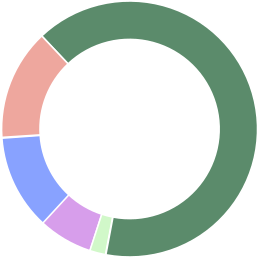
Asset Class Allocation
Portfolio Allocation
Allocation Range
Indicative Allocation
Australian Listed Property
0 - 99%
65%
International Listed Property
0 - 50%
14%
Direct Property
0 - 99%
12%
Infrastructure
0 - 50%
7%
Alternatives
0 - 50%
0%
Cash
1 - 30%
2%
Portfolio Description
A diversified portfolio of defensive assets. The portfolio is focused 100% on income generating defensive assets.
Investment Objective
RBA Cash Rate +2%
Significant Risks
- Interest rate risk: Interest rate movements may affect the value of interest-bearing securities both domestically and internationally.
- Economic risk: A downturn in economic growth (domestically or internationally) may adversely affect portfolio performance.
- Currency risk: Currency movements may affect the value of international investments.
- Concentration risk: A fall or rise in one investment or sector may have a material impact on the value of the portfolio.
- Liquidity risk: Understand that withdrawals from this Portfolio may be delayed due to the illiquid nature of the underlying assets and the terms of maturity/redemption for some of the underlying assets.
- Credit risk: The value of credit securities may be adversely impacted by default risk and rating downgrades.
- Counterparty risk: The risk of loss due to failure of a counterparty to meet its obligations.
- Volatility and price fluctuation: Understand and accept the risk of valuation fluctuations particularly over periods less than the minimum investment timeframe and that capital preservation is not guaranteed. I.e.; The value of the investment may fluctuate or fall within the period of the suggested minimum investment timeframe.
Breakdown

Defensive / Growth Portfolio Allocation
Portfolio Allocation
Allocation Range
Indicative Allocation
Defensive
100%
100%
Growth
0%
0%
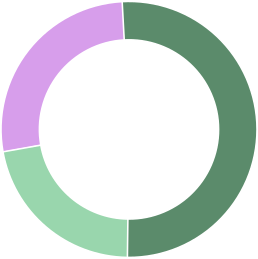
Asset Class Allocation
Portfolio Allocation
Allocation Range
Indicative Allocation
Australian Fixed Interest
30 - 100%
51%
International Fixed Interest
0 - 50%
27%
Alternatives
0 - 10%
0%
Cash
1 - 40%
22%
Portfolio Description
A concentrated long only portfolio and provides exposure to leading companies globally. The portfolio will typically be biased to large-cap companies in the US, UK, EU and Asia that have strong brands and dominant market positions in their respective industries.
The portfolio will generally be fully invested with investment in the portfolio being unhedged.
Investment Objective
The outperform the MSCI World ex Australia Net Returns Index (AUD) over rolling 7-year periods after fees.
Significant Risks
- Market risk: The risk associated with being exposed to a particular investment markets such as international share markets.
- Economic risk: A downturn in economic growth (domestically or internationally) may adversely affect portfolio performance.
- Concentration risk: A fall or rise in one investment or sector may have a material impact on the value of the portfolio.
- Currency risk: Currency movements may affect the value of international investments.
- Volatility and price fluctuation: Understand and accept the risk of valuation fluctuations particularly over periods less than the minimum investment timeframe and that capital preservation is not guaranteed. I.e., the value of the investment may fluctuate or fall within the period of the suggested minimum investment timeframe.
Breakdown

Defensive / Growth Portfolio Allocation
Portfolio Allocation
Allocation Range
Indicative Allocation
Growth
60 - 100%
99%
Defensive
0 - 40%
1%

Asset Class Allocation
Portfolio Allocation
Allocation Range
Indicative Allocation
International Shares
60 - 99%
99%
Cash
1 - 40%
1%